Coca-Cola semi-trailer
The Dog StarsThe Coca-Cola semi-trailer is both a practical cache in the post-collapse landscape and a small, recurring pleasure in Hig and Bangley’s guarded life. Its contents give Hig a reason to make supply runs and offer Bangley a peace offering; its discovery amid evidence of violence turns an ordinary drink into a contested resource. The trailer’s changing meaning—from locked container, to dependable provision, to the center of an armed encounter—makes it a measure of how difficult it is to separate everyday comfort from danger.
Discovery and Supply
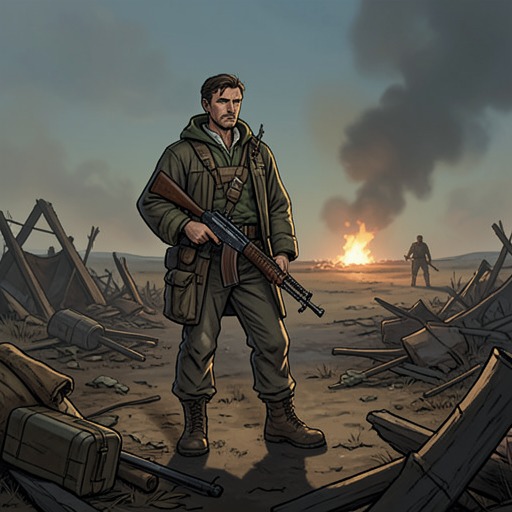
Hig first finds the truck while flying near Greeley, on a route that takes him past the power plant on the St. Vrain. It is a jackknifed double trailer, partly off a county road and partly into a farm driveway. The dirty red-and-white sides are visible from miles away. Five bodies around the vehicle, including one at the driver’s window, indicate that a gun battle has taken place there. Hig circles before landing. The scene suggests that the truck was attacked for its bottled water and drinks, though the account does not establish exactly who attacked whom.
On that first visit, Hig lands beside a farm pond and approaches the trailer with Jasper. The rear doors are secured by a simple brass U-lock. Hig walks to the farmhouse and crosses its muddy yard to find bolt cutters in the tractor shed, then opens the trailer. The cache is not simply waiting to be taken: its lock makes access a separate task, and the nearby evidence of violence gives the supply run a human cost. Hig loads three cases into The Beast. Before leaving, he ties a strip of a dead man’s red shirt to a mile marker to make a wind indicator, a practical detail that links the discovery to the demands of flying in a landscape where ordinary services no longer function.
A Shared Routine
The truck becomes part of Hig’s supply pattern. He already lands on a cleared boulevard in Commerce City every two months to restock ten cases of oil; on one trip he finds the drinks truck and begins bringing back four cases at a time. Two cases are for himself and two for Bangley. Hig also brings Sprite for families, a portion he keeps from Bangley. The arrangement turns a large, abandoned cache into a repeated, limited exchange rather than a single act of wholesale collection.
The supplies do not all endure equally well. Many cans have frozen and burst through repeated freeze-and-thaw cycles, while plastic bottles survive. That difference shapes what can still be carried away and consumed. Hig recognizes only later that the cans may eventually be ruined, but for a time the system works: he can return with a manageable number of cases and preserve the truck as a source for future visits. He also imagines that the supply might last for the years of their lives, finding in that small reserve a reason to celebrate despite the narrowness of those lives.
A later flight combines routine security work with the anticipated stop for drinks. Hig plans to circle over the meadows below Nederland and the peaks of the Continental Divide, check roads and trails, and make sure Bangley has had no visitors before landing for supplies. He has little need to scout the hills for game, but continues the low flight partly because he finds the foothills beautiful. The beverage run therefore sits alongside surveillance and hunting in the same itinerary: pleasure does not replace vigilance but is fitted into it. Hig even considers bringing Bangley Dr. Pepper as a surprise, while keeping a case of Sprite for the families.
The Cache Becomes a Threat
The trailer’s familiar role changes when Hig returns and sees its rear door slightly ajar. Jasper growls, his attention fixed on the back of the vehicle, and Hig follows his gaze to the open gap between the trailer doors. The warning interrupts the expected supply stop. Hig takes the AR-15 from its bracket beside Jasper’s seat, with the machine pistol close at hand. The truck that had made repeated trips feel predictable now signals that someone may be inside or near the cache.
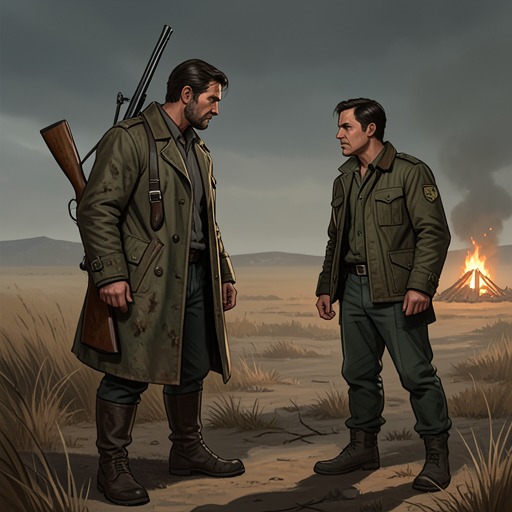
Hig encounters armed men at the truck and faces a choice between immediate violence and a risky concession. He tells one man to move his companion and load the cases, specifying fifteen cases of Coke and five of Sprite, with two additional cases of Dr. Pepper. Hig says that he will then board the plane and leave the rest. He acknowledges that once airborne he cannot prevent the men from taking what remains unless he kills them, a course he says he will not take. The drinks thus become bargaining material: Hig gives up control of most of the cache to avoid killing, even though the men remain close enough to pose a danger while loading.
That decision does not end peacefully. Hig later shoots one of the men, while the other abandons his cases and runs across the fields. The encounter leaves Hig sickened by the need to defend what he is supposed to protect and troubled by the question of what to do with so much Coke. The cache has made a nonlethal choice possible for a moment, but it cannot guarantee safety or prevent the confrontation from returning to violence.
Meaning and Aftermath
When Hig reports the encounter, Bangley criticizes the way he handled it. In Bangley’s view, allowing the men close during loading exposed them to attack, and offering the drinks could have secured information about other potential visitors. Bangley is particularly angered that Hig killed a man after the men had begun supplying information about a possible outside threat. His response gives the trailer’s contents a second strategic meaning: to Hig they are a treat and a means of avoiding bloodshed; to Bangley they are provisions that could have been exchanged for intelligence under controlled conditions.
The Coca-Cola semi-trailer therefore links comfort, scarcity, and risk without resolving their conflict. Its repeated use gives Hig and Bangley a modest domestic ritual, complete with the division of cases and an occasional proposed surprise. Yet the lock, the ruined cans, the evidence of the truck’s violent seizure, and the later open door all resist the idea that the cache is merely a convenient storehouse. What seems like an abundant supply has to be reached, preserved, apportioned, and defended. In the end, the drinks remain a small consolation, but the encounter shows how even a familiar pleasure can become a test of trust and survival.